

Variance Reduction for Comparisons of Means
The variance reduction method implemented in Confidence for comparisons of means is the “full regression adjustment” estimator discussed by Negi and Wooldridge (2021). The method is more precise than the original CUPED approach. Negi and Wooldridge propose to:- Regress on separately for treatment and control, where is the outcome, and is the pre-treatment variable.
- Estimate the treatment difference by , where is the estimated slope from the regressions, and are the sample means for each group, and is the overall sample mean of .
In experiments with multiple treatment groups, the control group’s
variance-reduced adjusted mean estimate differs between comparisons. This
happens because the overall sample mean of the pre-treatment variable,
, uses only the data from the groups involved in the specific
comparison. Depending on which treatment group you are comparing to the control
group, changes. Regardless, the variance-reduced treatment effect
estimate is generally a more precise estimate than the
unadjusted estimate, providing a more reliable measure of the treatment’s impact
on the metric of interest.
Variance Reduction for Comparisons of Ratios
The approach for reducing the variance through use of pre-exposure data resembles the method described in the earlier section when the metric of interest is a ratio metric. Confidence uses the method described by Jin and Ba (2023). Let and be the values for the numerator and denominator for unit . For example, could be the total number of searches for user , and their number of sessions. The ratio of interest is the group-level ratio . A difference in ratios between the groups estimates the treatment effect: To reduce the variance, Confidence applies regression adjustment separately to each of the four terms in the expression. Ultimately, this leads to adjusted estimates of the ratios in the two groups and a new estimate of the treatment effect. The adjustment reduces the variance of the ratios of the two groups, and the uncertainty surrounding the treatment effect is lower.Variance Reduction Rate
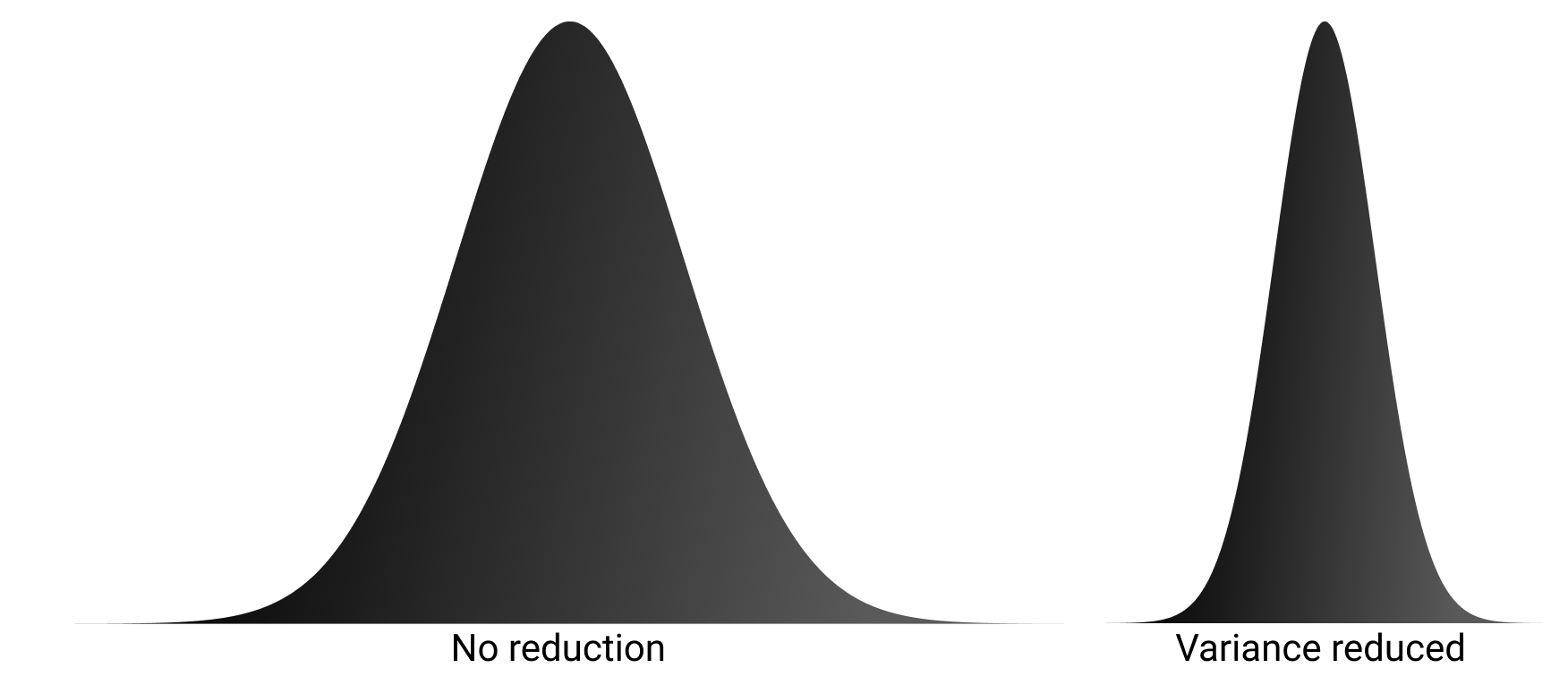
Variance reduction adjusts the comparison and reduces the variance as a result. Ultimately, the variance reduction rate summarizes the size of the reduction:Relative Values
When using variance reduction, reported relative values use the unadjusted estimates in the denominator. For a comparison of means, the reported relative value is .Interpret Results with Variance Reduction
Interpret the reported treatment effect for a metric that uses variance reduction in the same way as for a metric that doesn’t. The pre-exposure data helps produce a better signal of the treatment effect. Because the variance-reduced treatment effect differs from the unadjusted treatment effect, it can occasionally lead to a different conclusion than the unadjusted effect.Use Variance Reduction
Confidence enables variance reduction by default. To turn on variance reduction for a metric:- Go to Confidence and select Metrics on the left sidebar.
- Select the metric you want to enable variance reduction for and click Edit metric, or create a new metric.
- Expand Advanced options.
- Ensure that Variance reduction is checked.
- Optional. Select an aggregation window for the pre-exposure data.
References
- A. Deng, Y. Xu, R. Kohavi and T. Walker (2013) “Improving the sensitivity of online controlled experiments by utilizing pre-experiment data,” WSDM ‘13: Proceedings of the sixth ACM international conference on Web search and data mining.
- Y. Jin and S. Ba (2023) “Toward Optimal Variance Reduction in Online Controlled Experiments.” Technometrics.
- A. Negi and J. M. Wooldridge (2021) “Revisiting regression adjustment in experiments with heterogeneous treatment effects”, Econometric Reviews.
Related Resources
Metrics Reference
Configure variance reduction settings
Statistical Tests
Understand test types
Statistical Settings
Configure experiment parameters