> ## Documentation Index
> Fetch the complete documentation index at: https://confidence.spotify.com/llms.txt
> Use this file to discover all available pages before exploring further.
# Data Transfer
> Understand how your data flows through Confidence Flags.
Confidence offers two options for flags: a managed resolver and a self-hosted
resolver. With the managed resolver, Confidence operates the flag resolver
service for you. With the self-hosted resolver, you operate the resolver. Confidence
doesn't persist user-identifiable information in its operational storage. With the
managed resolver, the identifier and complete evaluation context pass through
Confidence services. If the context contains personally identifiable information
(PII), Confidence services receive that PII while processing the request. With the
self-hosted resolver, evaluation stays in your network. Apply data passes through
Confidence by default before Confidence writes it to your data warehouse.
## Data That Confidence Persists
The information that you pass to the resolver is:
* A unique ID to randomize on.
* A context with information to use for targeting. For example, `country` or `is_employee`.
Information that Confidence persists is:
* The number of resolves and the timestamp of the last resolve.
* The number of applies and the timestamp of the last apply.
* The names of the fields available in the context. The values of the fields in the context are
never stored.
The information that Confidence persists in your data warehouse is:
* The ID used for randomization.
* The context used in the resolve.
* The name of the flag.
* The name of the rule that determined what variant to give.
* The name of the variant that the user was exposed to.
## Managed Resolver
If you use the managed resolver, Confidence operates the flag resolver for you.
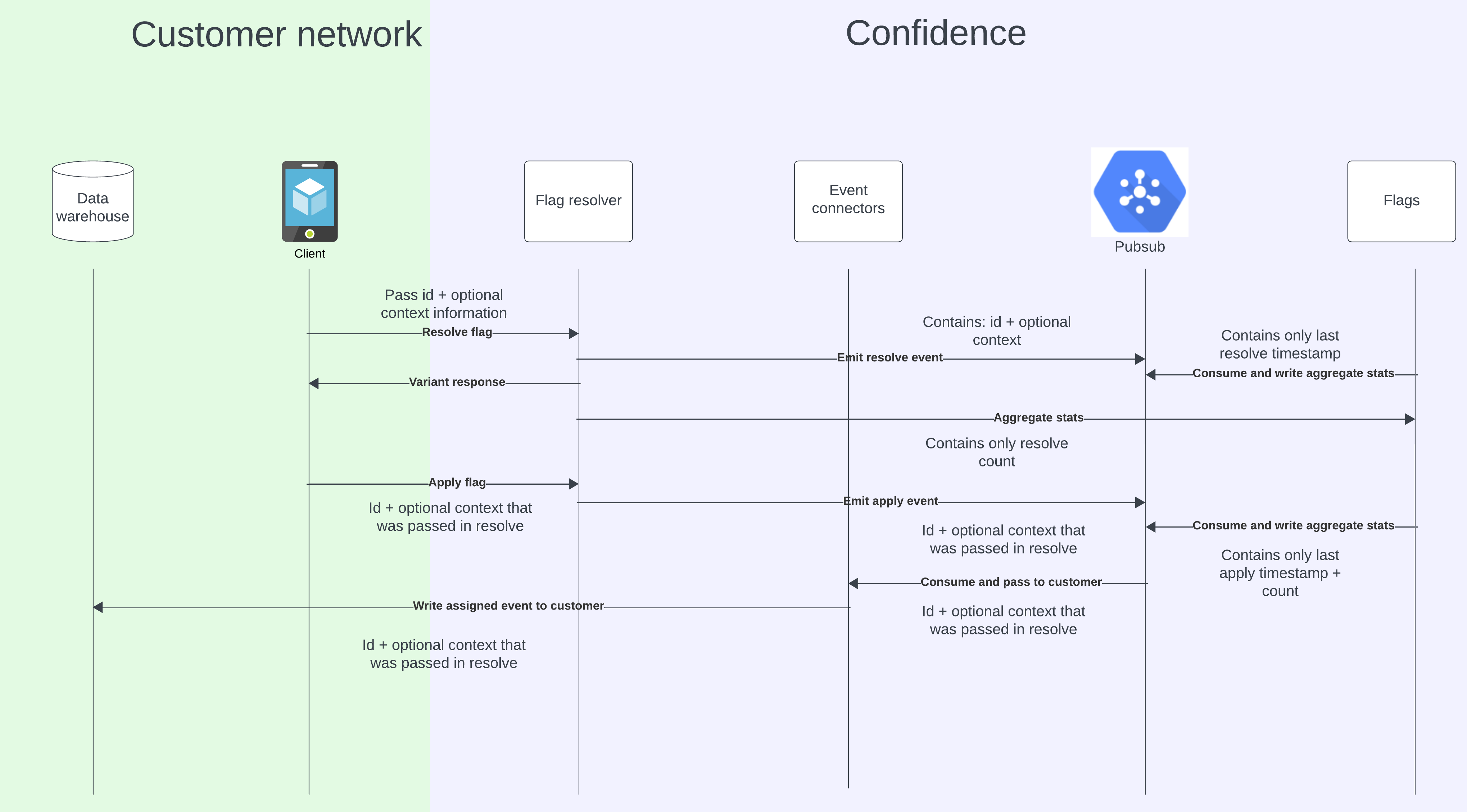
The following figure gives more details on how data flows through Confidence Flags in this case.
 The sequence of events are:
* A client resolves a flag by passing an ID and a context. It receives a variant.
* Confidence passes the ID and context to other internal services, but without storing the ID or
the values in the context. It only stores the schema of the context and aggregated information about
the number of resolves.
* When the client uses the variant, it also applies it by calling the apply endpoint. The apply
event similarly passes through Confidence, but only storing the number of applies.
* Confidence eventually writes the event to your data warehouse. At this point, neither the ID nor
the context is present in any part of Confidence.
## Self-Hosted Resolver
When using the self-hosted resolver, you operate the flag resolver.
The following figure gives more details on how data flows through Confidence Flags in this case,
and how the resolver communicates information back to Confidence.
The sequence of events are:
* A client resolves a flag by passing an ID and a context. It receives a variant.
* Confidence passes the ID and context to other internal services, but without storing the ID or
the values in the context. It only stores the schema of the context and aggregated information about
the number of resolves.
* When the client uses the variant, it also applies it by calling the apply endpoint. The apply
event similarly passes through Confidence, but only storing the number of applies.
* Confidence eventually writes the event to your data warehouse. At this point, neither the ID nor
the context is present in any part of Confidence.
## Self-Hosted Resolver
When using the self-hosted resolver, you operate the flag resolver.
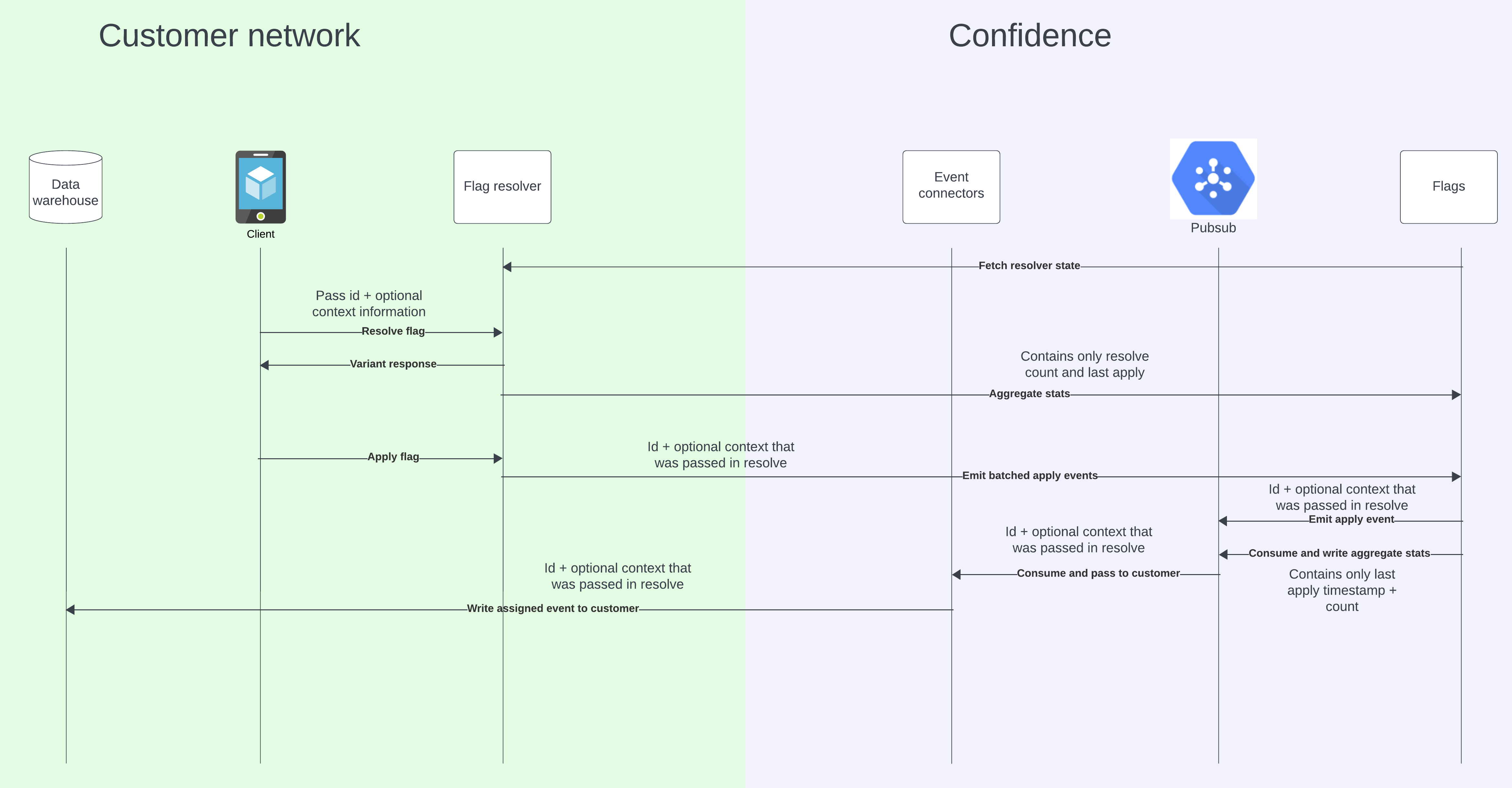
The following figure gives more details on how data flows through Confidence Flags in this case,
and how the resolver communicates information back to Confidence.
 The sequence of events are:
* A client resolves a flag by passing an ID and a context to the self-hosted resolver. It receives a variant.
* At regular time intervals, the self-hosted resolver sends the number of resolves and the schema of the
context to Confidence.
* When the client uses the variant, it also applies it by calling the apply endpoint. By default,
the self-hosted resolver forwards the apply event to Confidence, which only stores the number of applies.
* Confidence eventually writes the event to your data warehouse. At this point, neither the ID nor
the context is present in any part of Confidence.
You can set `CONFIDENCE_SEND_APPLY_LOGS` to `false` to keep apply data within your network. The
self-hosted resolver continues to accept apply requests, but doesn't send assignment events or apply distinct
counts to Confidence. Resolve telemetry, aggregate operational metadata such as the apply request
rate, and resolver-state synchronization remain enabled.
Disabling apply logs degrades Confidence functionality. Confidence can't observe which entities
were exposed to each variant. Experiments and rollouts that use flags resolved by this resolver
won't work correctly: exposure counts, experiment results, and rollout monitoring will be missing
or incomplete. Only disable apply logs if you accept this loss of functionality or provide
equivalent assignment data through another source.
Read how to [set up a self-hosted resolver](/docs/capabilities/flags/local-resolver#self-hosted-resolver), either as a shared service or a sidecar.
## Related Resources
Resolver configuration options
Configure your data warehouse
The sequence of events are:
* A client resolves a flag by passing an ID and a context to the self-hosted resolver. It receives a variant.
* At regular time intervals, the self-hosted resolver sends the number of resolves and the schema of the
context to Confidence.
* When the client uses the variant, it also applies it by calling the apply endpoint. By default,
the self-hosted resolver forwards the apply event to Confidence, which only stores the number of applies.
* Confidence eventually writes the event to your data warehouse. At this point, neither the ID nor
the context is present in any part of Confidence.
You can set `CONFIDENCE_SEND_APPLY_LOGS` to `false` to keep apply data within your network. The
self-hosted resolver continues to accept apply requests, but doesn't send assignment events or apply distinct
counts to Confidence. Resolve telemetry, aggregate operational metadata such as the apply request
rate, and resolver-state synchronization remain enabled.
Disabling apply logs degrades Confidence functionality. Confidence can't observe which entities
were exposed to each variant. Experiments and rollouts that use flags resolved by this resolver
won't work correctly: exposure counts, experiment results, and rollout monitoring will be missing
or incomplete. Only disable apply logs if you accept this loss of functionality or provide
equivalent assignment data through another source.
Read how to [set up a self-hosted resolver](/docs/capabilities/flags/local-resolver#self-hosted-resolver), either as a shared service or a sidecar.
## Related Resources
Resolver configuration options
Configure your data warehouse